Key takeaways
- X by XREAL a01+ went on sale in the US on 10 July 2026 for $299, through Amazon, Best Buy, B&H and Micro Center, after launching first in China.
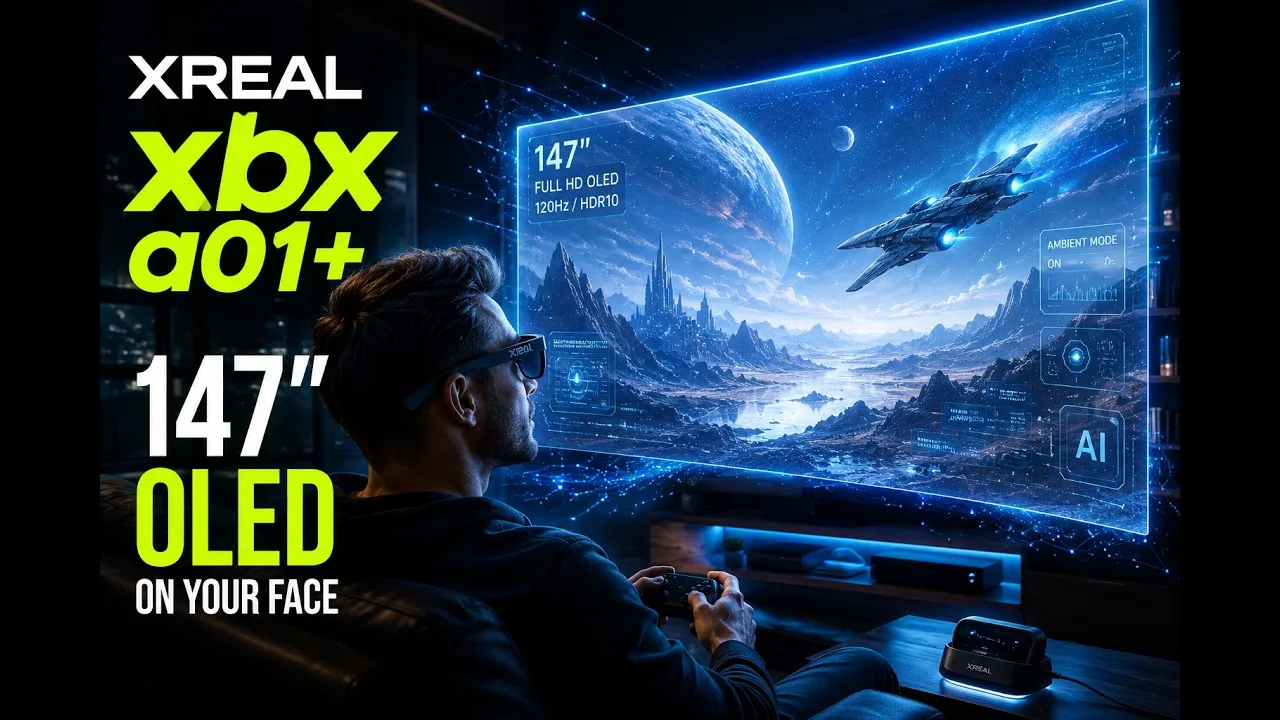
- 62 grams, a 50-degree field of view, 120 Hz, and a virtual screen XREAL rates at 147 inches. No camera, no AI, no app store.
- They plug into anything with USB-C video out: most Android phones, iPhone 15 and later, Steam Deck, laptops, and a Switch with an adapter.
- This is display glasses, not spatial computing. That is the point. It is the one kind of smart glasses with a mass market, and XREAL just cut its price by a third.
Every few months a company shows glasses that put a hologram on your kitchen table, and every few months the glasses cost more than the table and the kitchen. XREAL has spent five years doing something less cinematic. It makes glasses that show you a big screen, and it keeps making them cheaper. In July 2026 it launched a budget sub-brand, X by XREAL, and a pair called the a01+ at $299. We have been wearing them on trains, in bed and on a sofa we were supposed to be sharing. Here is what $299 buys.
What they are, in one sentence
They are a 1080p screen per eye, mounted in a pair of sunglasses, that mirrors whatever you plug them into over a USB-C cable. There is no battery to charge because they draw power from the phone. There is no camera, so there is nothing to feel awkward about in a café. There is no operating system, so there is nothing to update. You plug them in and the thing on your phone is now the size of a wall.
XREAL's own number for that wall is 147 inches, which assumes a viewing distance you would never sit at from a real TV. The honest comparison is a decent cinema seat about two-thirds of the way back. At 120 Hz, games feel right, and the 50-degree field of view is wide enough that a 16:9 picture fills most of what you see without you having to move your eyes to the corners.
What you give up versus the $449 ones
XREAL's own 1S costs $449 and the One Pro more again, and the a01+ is cheaper for reasons you can see on the spec sheet:
- Field of view: 50 degrees against 57 on the One Pro. The screen is a little smaller and a little further away.
- No X1 chip. The pricier glasses have a processor that can pin the screen in space so it stays put when you turn your head. On the a01+ the screen follows your face everywhere, like a very polite ghost. Fine for films, slightly annoying for work.
- No electrochromic dimming. You get a clip-on blackout shade instead of lenses that darken at the press of a button.
- Audio is open-ear speakers in the arms. They are fine. People next to you on the train will hear a whisper of your film.
Against that, the a01+ weighs 62 grams, about 20 less than the 1S, and the difference matters after an hour. Glasses you forget you are wearing are glasses you keep wearing.
The train test

The use case that justifies every pair of display glasses ever sold is the long commute, so that is where we started. Phone in a pocket, cable up the sleeve, glasses on, Steam Deck on the lap for the second leg. Two observations.
First, nobody looks. In 2018 a headset on public transport got you photographed. The a01+ look like slightly chunky sunglasses, and the only thing that gives you away is the cable. Second, the lack of a camera is a feature in exactly this setting. You are the one person in the carriage who cannot possibly be recording anyone, and that is worth more than any AI assistant.
Picture quality is the surprise. Micro-OLED panels are black where they should be black, which on a dark train makes the picture look like it is floating in nothing. Text is sharp enough to read a document, though not for long. A two-hour film is comfortable. A full working day is not, and XREAL would be the first to say so.
Why $299 matters more than $2,195
Snap's Specs cost $2,195 and come with Robert Downey Jr.. Meta's 2027 VR Glasses cost $1,300 and come with a puck in your pocket. Both are trying to invent a new category. XREAL is not. It has figured out that most of what people want from glasses with a screen in them is a screen in them, and that the thing that stopped them buying was the price, not the lack of holograms.
The economics write themselves. A $299 accessory is an impulse buy for anyone who already owns a Steam Deck or flies twice a year. A $2,195 computer is a decision. XREAL has sold hundreds of thousands of its earlier glasses on the back of that difference, and the a01+ halves the barrier again. If smart glasses ever become normal, it will be because of products like this one, not because of the keynotes.
Who should buy them
- Buy if you have a Steam Deck, a long commute, a small flat, or a partner who wants the TV.
- Buy the 1S or One Pro instead if you want the screen to stay still in space while you move, or if you plan to work in them.
- Do not buy if you expect anything to float over the real world. There is no camera and no tracking. This is a monitor you wear.
- Check your phone. It needs USB-C with DisplayPort output. Most Android flagships and iPhone 15 or later qualify; older iPhones and some budget Androids do not.
Verdict
The a01+ are the first display glasses we would recommend to someone who has never heard of XREAL, mainly because they cost about the same as a pair of good headphones and do roughly one job as well as good headphones do theirs. They are not the future of computing. They are a very good screen that weighs 62 grams, and in a year when the industry is arguing about four-figure face computers, that is a refreshingly small ambition to see delivered.